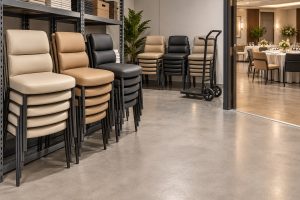
Furniture Minimum Order Quantity for Replacement Chairs: Negotiate the Right Program
Discuss replacement-chair order minimums through model continuity, small shipments and planned reserves rather than assuming every reorder has the same terms.
Furniture minimum order quantity for replacement chairs can become a problem long after the first delivery. The original bulk purchase may meet a supplier’s minimum easily, while a later need involves only a few units in a particular finish. Resolve that distinction during procurement. Ask how a replacement order will be handled, which conditions apply to the exact configuration, and what options exist if the model or finish changes.
Define the replacement demand
Separate the room’s initial quantity from likely replacement or expansion needs. Use your operating records where available, and label any future estimate as an assumption. Explain whether replacements must match existing chairs precisely or can be allocated to a separate group. This affects the practical options. A standard finish may have a different availability route from a project-specific configuration, but only the current supplier proposal can establish the terms for your order.
Ask whether the minimum applies by model, finish, upholstery, carton, or total shipment. These are different constraints. Clarify whether mixed variants count together and whether small replacement quantities can be supplied later. Do not assume that a website’s general minimum or a previous quotation applies to every subsequent order. Keep any agreed exception connected to the original project reference and specify whether it depends on stock, production scheduling, or another stated condition.
Compare the possible arrangements
Options may include purchasing a defined reserve with the original order, agreeing on a small-order route, or choosing a configuration with a practical repeat-order arrangement. None is automatically the cheapest. Reserve units consume space and money, while small shipments can involve separate handling and delivery costs. Ask for the actual quoted scope rather than inventing a saving. Where the supplier cannot commit to future availability, make that uncertainty part of the purchasing decision.
Avoid buying excess variants solely to meet a minimum when they have no clear use in the room. A chair that does not fit the retained tables is not valuable contingency stock. Likewise, an unrelated finish may create a mismatch instead of solving a shortage. If the required configuration becomes unavailable, use a controlled alternative approval process. An apparently convenient substitution should still be checked for table fit, operating use, and appearance before it enters service.
Preserve the repeat-order reference
Retain the model, finish, seat specification, accepted dimensions, and supplier response on replacement quantities. Ask how proposed changes will be identified on future quotations and packing records. Hengyou’s finished metal dining chair listing is a suitable enquiry starting point; confirm order minimums and support terms for your exact purchase. Review the arrangement when room quantities or operating needs change. The objective is not a universal promise of unlimited small orders. It is a documented replacement path that the business understands before a missing chair turns into an urgent purchasing problem.
Share this article: