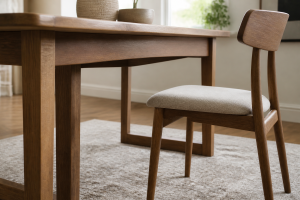
A sculptural dining table can lose its strongest feature after the chairs arrive. Wide backs form a visual wall, heavy legs crowd the base, and six assertive silhouettes compete for attention. The chairs may be attractive individually, yet the whole setting feels busier and more formal than intended.
Quick answer: the best dining chairs for a statement table repeat one small design cue while remaining quieter in mass, color, or line. Measure the table apron and base before shopping, preserve a clear view from the room entrance, and choose comfort through seat dimensions rather than extra visual bulk.
Key Takeaways
- Let either the table or the chairs lead; two dominant forms usually compete.
- Open backs, slim legs, and lower profiles reveal a pedestal or sculptural base.
- Allow about 24 inches (61 cm) of table edge per diner and 36 inches (91 cm) behind occupied chairs where possible.
- Repeat one feature such as a curve, wood tone, or black accent rather than matching every detail.
- Test seat height, apron clearance, and chair width as one system.
Decide What Deserves the First Look
Stand at the dining room entrance and identify the first object you want people to notice. If it is the table base, avoid a continuous row of tall opaque chair backs. If the tabletop has expressive veining, a calm upholstered chair can frame it. A modern pedestal dining table already carries strong vertical rhythm, so simple chairs often make the composition clearer.
This does not mean every chair must disappear. A controlled echo creates cohesion. Rounded corners can pair with a curved back, a dark base can connect to black chair legs, and a warm tabletop can relate to walnut details. Stop after one or two links; exact matching can make the room look like a showroom set rather than a considered interior.
Measure the Table Before Comparing Chair Styles
| Measurement | Practical target | Why it matters |
|---|---|---|
| Seat height | About 17-19 in (43-48 cm) | Usually works with standard 28-30 in tables |
| Seat-to-apron space | About 10-12 in (25-30 cm) | Protects thigh and knee clearance |
| Edge per diner | About 24 in (61 cm) | Prevents elbows and arms from colliding |
| Chair clearance | 36 in (91 cm), more on traffic routes | Allows a chair to pull out while people pass |
Measure the narrowest distance between base elements as well as the tabletop length. A six-foot table can theoretically seat six, but a wide double pedestal may limit where chair legs and feet can go. Armchairs require extra width and can strike a thick apron. A slim armless dining chair generally protects flexibility when the base is the visual feature.
Chair Shapes That Keep a Sculptural Base Visible
Open or Low Backs
An open-back chair creates negative space through which the base remains visible. A lower back also reduces the visual barrier when the table is viewed from the living area. A modern curved dining chair can echo a rounded top without becoming a second sculpture.
Slim, Set-Back Legs
Legs that sit beneath the seat read as a compact unit and are less likely to overlap the table base. Splayed legs add energy but need careful spacing. Rotate a sample chair under the table and check it from several angles before ordering a full set.
Quiet Upholstery
Plain woven fabric, restrained faux leather, or a soft neutral can add comfort while allowing stone, wood, or fluting to lead. A minimalist dining chair is useful when the table already combines several materials.
Comfort Without Excess Bulk
Visual lightness should not require a shallow, hard seat. Compare usable seat width, depth, back angle, and foam density. A gently curved back can support the lower ribs with less material than a thick winged design. For long dinners, use a sample for at least 20 minutes and note whether the front edge presses behind the knees.
Material should match service conditions. Performance fabric helps in family dining rooms; sealed faux leather wipes quickly in hospitality settings; solid wood offers longevity but may need a shaped seat or removable pad. The walnut dining chair collection provides a warmer counterpoint when a stone top feels cool.
Common Pairing Mistakes
- Choosing from a front photograph: side and rear views determine how much of the base is concealed.
- Matching every curve: repetition without contrast makes the setting visually restless.
- Ignoring the apron: a comfortable chair can become unusable when armrests or thighs hit the underside.
- Buying six before testing one: small dimensional errors multiply around the table.
- Adding oversized end chairs: they often block circulation and break the table’s silhouette.
A Simple Selection Framework
- Photograph the empty table from the room entrance and main adjacent seating area.
- Mark the chair zones on the floor and verify that each place avoids the table base.
- Choose one shared cue: line, color, finish, or proportion.
- Make the chairs quieter in at least two other ways.
- Test one chair for comfort, clearance, wobble, and floor protection.
- Place all chairs, remove two, and compare whether the room works better with fewer seats.
Specification Checklist
- Overall width, depth, and back height
- Usable seat width and depth
- Seat height under load
- Arm height, if applicable
- Frame material and joint construction
- Upholstery abrasion rating and cleaning code
- Maximum tested load and commercial-use certification
- Floor glides, replacement parts, carton size, and assembly method
B2B Sourcing Checklist
For restaurant, hotel, or project orders, request a physical sample and a dimensioned drawing. Confirm color tolerance between batches, fabric fire requirements for the destination market, static load testing, spare upholstery, leg-finish durability, and replacement glide availability. Photograph the chair with the actual table or a full-size base template before approving production.
Related Product Directions
Compare the open silhouette of a wooden dining chair with the softer profile of an upholstered dining chair. The better option is the one that keeps the table’s defining feature visible while meeting the room’s real comfort and maintenance needs.
Conclusion
A statement table does not need invisible chairs; it needs a clear hierarchy. Preserve the important sightline, repeat one design cue, and confirm the full set with dimensions. When scale and clearance are right, restrained chairs make the table more memorable and the room easier to use.
Frequently Asked Questions
Should dining chairs match a statement dining table?
They should relate rather than match exactly. Repeating one curve, finish, or color creates cohesion while differences in mass and detail keep the table visually dominant.
What chair back keeps a table base visible?
Open backs and lower profiles usually reveal more of a pedestal or sculptural base. Check the view from the room entrance because chair height alone does not predict visual blockage.
How much space does each dining chair need?
Allow roughly 24 inches of table edge per diner as a starting point, then increase it for wide seats or arms. Verify that chair legs do not collide with pedestal elements.
Can upholstered chairs work with a sculptural table?
Yes. Choose a compact silhouette and restrained fabric, then confirm seat comfort, cleaning performance, and underside clearance with a sample.