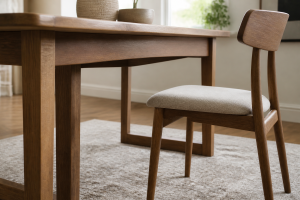
The useful way to think about coffee table beside patio door is to compare the furniture in use, not perfectly tucked away. Beside a patio door, the route governs the coffee table. Keep the active door panel, curtain stack, and indoor-outdoor traffic free before deciding how much surface the seating can support.
Quick answer: Mark the open door and a 36-inch carrying route first, then place the table 14-18 inches from the sofa only within the remaining footprint. Treat this as a planning benchmark, then verify the actual product, room, users, and supplier documentation.
Decision Summary
- Beside a patio door, the route governs the coffee table. Keep the active door panel, curtain stack, and indoor-outdoor traffic free before deciding how much surface the seating can support.
- Mark the open door and a 36-inch carrying route first, then place the table 14-18 inches from the sofa only within the remaining footprint.
- identify the panel people actually use
- include wet shoes and serving trays in the route test
Plan the Active Furniture State
Living rooms change between quiet evenings, guests, cleaning, play, and access to nearby doors. A table that works in only one staged arrangement soon becomes an obstacle. Mark the normal position and the most demanding temporary position, then make sure both leave a simple route that nobody has to learn.
Write down who uses the space, what they carry, how long they remain seated, and which route or function cannot be compromised. Include the awkward moment: a chair pulled out, a drawer open, a table extended, a pet turning at speed, or staff resetting a room. A decision that works in that moment usually feels effortless during ordinary use.
A Three-Part Room Test
Map: Identify The Panel People Actually Use
identify the panel people actually use. Run the check in the normal active position, then repeat it in the most demanding position. The solution should not depend on everyone remembering a special workaround.
Test: Include Wet Shoes And Serving Trays In The Route Test
include wet shoes and serving trays in the route test. Treat this as a pass-or-revise decision. If the result is unclear, use a full-size cardboard or tape mock-up before money, delivery, or installation narrows the options.
Record: Check Glare And Temperature Near The Glass
check glare and temperature near the glass. Record the result in inches and centimeters and take one photograph from the normal approach. A visible record prevents memory from turning a tight fit into an optimistic one.
Measure More Than the Top
Mark the open door and a 36-inch carrying route first, then place the table 14-18 inches from the sofa only within the remaining footprint. Measure the narrowest point and the occupied condition; averaging a generous side with a tight side hides the problem.
| Check | Record | Pass condition |
|---|---|---|
| Room envelope | Walls, doors, fixed storage, lighting and main route | The active furniture state preserves required access |
| Human fit | Reach, clear width, posture, knee space and pull-out movement | Regular users complete the task without collision |
| Product geometry | Top, seat, base, legs, edges, glides and moving parts | Every projection fits in stored and working states |
| Care cycle | Cleaner, drying, adjustment, repair and spare components | Maintenance fits available labor and downtime |
Where Buyers Lose Useful Space
- Scale: centering the table on the sofa while blocking the door. Correct this during the mock-up or sample review, while the specification can still change.
- Use: forgetting curtains project into the room. Correct this during the mock-up or sample review, while the specification can still change.
- Construction: using a moisture-sensitive edge beside outdoor traffic. Correct this during the mock-up or sample review, while the specification can still change.
- Care: planning for one person instead of two-way movement. Correct this during the mock-up or sample review, while the specification can still change.
Surface and Service-Life Trade-Offs
Use the occupied sofa cushion as the height reference. Soft seats compress, so an unloaded measurement can exaggerate the relationship. Sit naturally with feet on the floor, place a tray where the table will be, and notice whether the reach requires a forward lunge or raised shoulder.
Request the material name, construction, finish, approved cleaning method, prohibited chemicals, and replacement route in writing. Inspect edges, seams, underside fixings, and floor-contact parts because these areas reveal wear before the broad visible surface. Test the intended cleaner on the exact sample and judge it only after drying.
Build a Shortlist With Evidence
- Define the non-negotiable job. Name the users, activity, peak condition, route, and cleaning cycle.
- Map the active footprint. Include people, pulled-out chairs, moving parts, bases, doors, and temporary positions.
- Reject incomplete specifications. Ask for drawings, construction, finish care, test context, hardware, and parts.
- Trial one accurate sample. Use it in the tightest position, move it, clean it, and inspect every contact point.
- Keep the approval record. Save dimensions, photographs, finish sample, care method, and replacement references.
What to Put on the Product Sheet
- Top width, length or diameter
- Finished height
- Floor-level base footprint
- Edge profile and corner radius
- Top construction and approved care
- Hardware, glides and replacement parts
Project and Quantity-Order Checks
For a project or multi-unit order, request a dimensioned drawing, accurate finish sample, carton size, assembly sequence, floor-protection method, spare hardware, care sheet, and color-tolerance standard. Approve the tightest room and most difficult seat with a production-representative sample.
Verify destination-specific accessibility, fire, egress, installation, and testing obligations with qualified project professionals. Keep one approved control sample so later deliveries can be compared with something more precise than memory or screen color.
Products to Compare
Use the published dimensions and construction details as comparison points, then confirm the current specification for the intended project. Start with the multi-function nesting coffee table, modern coffee table, and split round coffee table. A different footprint can be compared through the sleek round coffee table, storage marble coffee table, and dual-tier marble coffee table.
Use a One-Page Decision Record
A short written record makes the choice easier to review when several people are involved. Add columns for room fit, user comfort, daily cleaning, repair access, supplier documentation, delivery risk, and total replacement cost. Note which claims came from a drawing, a physical sample, or a general description. For coffee table beside patio door, give the highest weight to identify the panel people actually use and check glare and temperature near the glass. Record any compromise in plain language so it can be checked again after installation. This prevents a minor styling preference from quietly overriding a route, stability, comfort, or maintenance requirement.
Check the Decision After Delivery
Recheck coffee table beside patio door after the furniture has been used for one week and again after the first month. Confirm that routes remain clear at busy times, chairs and moving parts still operate without contact, the finish responds well to normal cleaning, and the chosen dimensions still support everyday tasks. Record any adjustment while the order details and supplier support information are easy to retrieve.
The Practical Decision
Beside a patio door, the route governs the coffee table. Keep the active door panel, curtain stack, and indoor-outdoor traffic free before deciding how much surface the seating can support. For coffee table beside patio door, the strongest decision is the one that remains comfortable, clear, and serviceable after the room changes from a photograph into daily use.
Frequently Asked Questions
What should I measure first for coffee table beside patio door?
Mark the open door and a 36-inch carrying route first, then place the table 14-18 inches from the sofa only within the remaining footprint.
How can I test coffee table beside patio door before buying?
Start with identify the panel people actually use. Then include wet shoes and serving trays in the route test, and finish by confirming that check glare and temperature near the glass. Use the real room or a full-size mock-up.
Which mistake matters most with coffee table beside patio door?
The most expensive early mistake is centering the table on the sofa while blocking the door. It can distort every later style and material decision, so resolve it before ordering.
What should a supplier document for coffee table beside patio door?
Ask for a dimensioned drawing, material and finish construction, care limits, intended-use statement, relevant test context, assembly information, and replaceable-part details.