Restaurant Table Tops for High-Traffic Dining
A material-selection method based on what actually damages restaurant table tops during service.
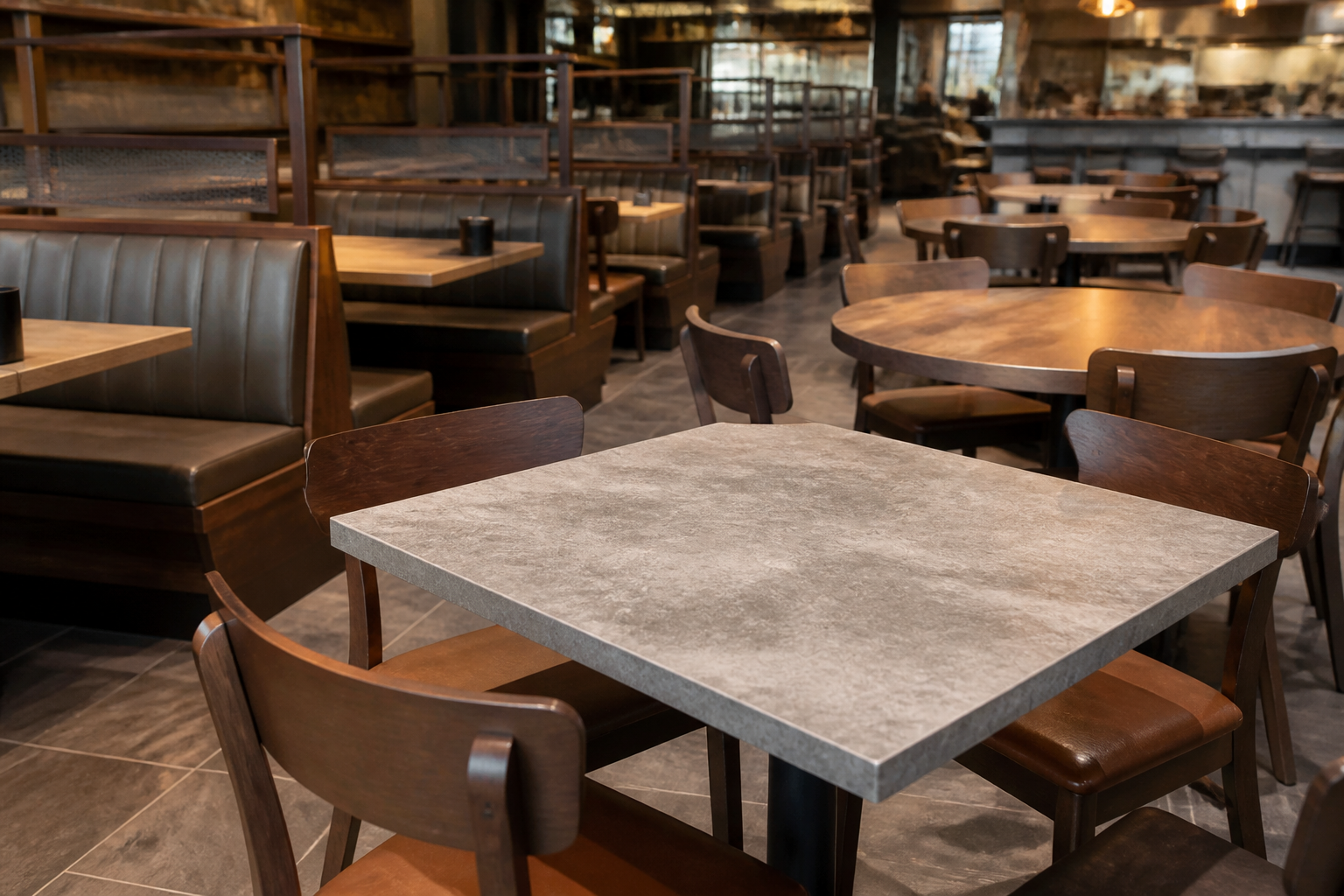
Restaurant Table Tops for High-Traffic Dining is a practical question because furniture can look balanced in a photograph and still fail once chairs move, people sit, doors open, or staff begin service. Avoid declaring one universal winner and match materials to operating conditions and maintenance capacity.
The goal is not to force one universal rule. It is to create a repeatable way to compare size, comfort, movement, materials, maintenance, and future replacement before money is committed.
Quick Answer
Define the venue’s damage pattern first: hot plates, sanitizer, standing water, edge impacts, cutlery scratches, or outdoor exposure. Then compare the complete top, including core, edge, finish, and repair method.
Key Takeaways
- Measure the active setup, not the furniture while everything is tucked away.
- Test the most constrained seat, route, edge, or operating condition first.
- Treat material, structure, cleaning, and replacement as one decision.
- For project orders, approve a sample and document the exact specification.
Start With the Real Use Case
A restaurant plan has to survive full occupancy, not just look clear on a drawing. Model chairs pulled out, servers carrying trays, combined tables, waiting guests, reset carts, and the largest common party. Confirm local capacity, egress, and accessibility requirements with the appropriate professionals.
For this topic, the most useful starting point is simple: List cleaners, heat sources, spills, and reset frequency. That first test establishes whether the furniture supports the room’s main job. It also stops secondary styling decisions from distracting attention from a basic fit or movement problem.
A Five-Step Room Test
1. List cleaners, heat sources, spills, and reset frequency
Start by making this visible in the real room. List cleaners, heat sources, spills, and reset frequency. For restaurant table tops for high traffic, the useful result is a measurement, observation, or approved detail that another buyer or installer can verify.
2. Inspect edge construction and underside sealing
This should be checked with the furniture in use. Inspect edge construction and underside sealing. For restaurant table tops for high traffic, the useful result is a measurement, observation, or approved detail that another buyer or installer can verify.
3. Request finish and color samples
Treat this as a pass-or-fail test, not a styling preference. Request finish and color samples. For restaurant table tops for high traffic, the useful result is a measurement, observation, or approved detail that another buyer or installer can verify.
4. Test stain and cleaner compatibility
Record the result before approving the final specification. Test stain and cleaner compatibility. For restaurant table tops for high traffic, the useful result is a measurement, observation, or approved detail that another buyer or installer can verify.
5. Plan how damaged tops will be repaired or replaced
Repeat the test under the busiest realistic condition. Plan how damaged tops will be repaired or replaced. For restaurant table tops for high traffic, the useful result is a measurement, observation, or approved detail that another buyer or installer can verify.
Size, Layout, and Clearance
A restaurant plan has to survive full occupancy, not just look clear on a drawing. Model chairs pulled out, servers carrying trays, combined tables, waiting guests, reset carts, and the largest common party. Confirm local capacity, egress, and accessibility requirements with the appropriate professionals.
| Decision Point | What to Check | Why It Matters |
|---|---|---|
| Check 1 | List cleaners, heat sources, spills, and reset frequency | Establishes the true footprint |
| Check 2 | Inspect edge construction and underside sealing | Protects movement and access |
| Check 3 | Request finish and color samples | Reveals compatibility problems |
| Check 4 | Test stain and cleaner compatibility | Improves comfort and maintenance |
| Check 5 | Plan how damaged tops will be repaired or replaced | Creates an approval record |
Materials and Maintenance
Commercial furniture is exposed to dynamic loading, sanitizer, edge impacts, hot serviceware, wet wiping, stacked storage, and repeated relocation. Review joinery, welds, fasteners, top edges, cores, coatings, levelers, glides, and parts support before comparing decorative finishes.
Ask for care instructions before selecting a finish. Test the proposed cleaner on a sample and inspect the edges, underside, joints, glides, and hardware that product photos rarely show. A surface that cleans easily but exposes a fragile edge or inaccessible joint is not a low-maintenance specification.
Common Mistakes
Choosing by surface name alone
This usually happens when a product photo replaces a floor test. Choosing by surface name alone. The practical fix is to return to the active footprint, intended users, and maintenance routine, then revise the specification rather than hiding the symptom.
Ignoring the edge and core
The problem may stay hidden until every seat is occupied. Ignoring the edge and core. The practical fix is to return to the active footprint, intended users, and maintenance routine, then revise the specification rather than hiding the symptom.
Using residential finishes in constant service
It often creates extra cleaning, movement, or repair work later. Using residential finishes in constant service. The practical fix is to return to the active footprint, intended users, and maintenance routine, then revise the specification rather than hiding the symptom.
Testing only with water
A sample or taped layout normally reveals it early. Testing only with water. The practical fix is to return to the active footprint, intended users, and maintenance routine, then revise the specification rather than hiding the symptom.
Ordering a custom color with no future replacement path
Correcting it before ordering is faster than redesigning the room later. Ordering a custom color with no future replacement path. The practical fix is to return to the active footprint, intended users, and maintenance routine, then revise the specification rather than hiding the symptom.
Product Selection Framework
Build the specification from operating data: party mix, menu footprint, turns, cleaning routine, room resets, floor condition, and replacement strategy. Then choose compatible furniture modules and document approved combinations.
| Decision Point | What to Check | Why It Matters |
|---|---|---|
| Fit | Active dimensions, occupied clearances, reach, and movement | Reject options that fail the room test |
| Use | Visit length, seating posture, menu or household activities | Match furniture to the main daily job |
| Construction | Frame, base, joints, top, edge, glides, and mechanisms | Look beyond the decorative surface |
| Care | Spills, cleaners, sunlight, scratches, and access | Choose a finish the owner can maintain |
| Continuity | Samples, codes, parts, packing, and reorder terms | Keep later replacement practical |
Specification Checklist
- Focus topic, page title, and URL all match restaurant table tops for high traffic.
- Overall and active dimensions are recorded with units and tolerances.
- The lowest clearance, widest movement, and most constrained position are checked.
- Material, finish, base or frame, edge, glides, and hardware are approved.
- Cleaning instructions and a sample test are on file.
- Packing, assembly, lead time, spare parts, and reorder support are confirmed.
B2B Sourcing Checklist
For a bulk order, turn the room test into an approval document. Include dimensioned drawings, close-up photos, finish samples, chair or table pairings, acceptable tolerances, carton details, installation notes, and inspection points. Ask the supplier to identify which details may change in later batches and how replacements will be matched.
A production-close sample should be tested in context. Move it, sit at it, clean it, inspect the underside, and place it on the actual floor or a representative surface. Record the approved result with photos and measurements so the same decision does not have to be reinvented at delivery.
Related Furniture Options
Compare the proportions, surfaces, and base behavior of modern white dining table, modern marble dining table, round rock slab dining table, modern coffee table, sleek round coffee table, contemporary marble coffee table, contact our furniture team. Use these pages as visual and specification references, then confirm the final dimensions for the actual room.
Final Decision
A strong restaurant table tops for high traffic decision should survive four questions: Does it fit while in use? Is it comfortable for the intended visit or activity? Can it be cleaned and maintained with the available routine? Can the same specification be supported or replaced later? If one answer is uncertain, return to the sample or floor test before ordering.
That disciplined check produces a better room than adding more decoration around a furniture mismatch. It also gives homeowners, designers, operators, and sourcing teams a shared set of facts for approving the purchase.
FAQ
What should I check first for restaurant table tops for high traffic?
Start with the real use case and active footprint. Measure the furniture while occupied or operating, then protect the necessary route, reach, and maintenance access.
How can I test restaurant table tops for high traffic before ordering?
Use painter’s tape, a sample chair or table, and the actual room. Recreate normal use, full use, cleaning, and any moving parts rather than judging an empty setup.
Which material is best for restaurant table tops for high traffic?
There is no universal winner. Choose by spills, heat, sunlight, cleaning chemicals, scratches, repair expectations, weight, and how often the furniture moves.
What should commercial buyers document?
Record dimensions, tolerances, material and finish codes, base or frame details, glides or levelers, packing, lead time, sample approval, spare parts, and reorder terms.
How do I avoid ordering the wrong furniture?
Approve one realistic sample or mock layout, test it with the neighboring furniture, and keep the final measurements and finish references in writing.
Share this article: