Restaurant Furniture Moves per Week: A Better Durability Brief for Flexible Dining Rooms
Turn weekly table and chair moves into a measurable restaurant furniture specification that protects layouts, staff, floors, and long-term replacement budgets.
Quick answer: A flexible restaurant should specify tables and chairs by expected moves per week, not only by years of service. Count resets, joining and separating tables, stacking cycles, patio clear-downs and cleaning moves. Then test the sample, glides, joints, finishes and staff workflow against that number. Furniture that is excellent when static can fail quickly when it is moved fifty times every week.
Private dining, changing party sizes and seasonal layouts make flexibility valuable, but every move is a small load event. Staff grip an edge, twist a frame, bump a base or drag a glide across a floor. These actions are predictable. Treating them as a design input gives buyers a better brief and helps suppliers recommend a suitable rounded dining table, chair construction and replacement-parts plan.
Turn movement into a procurement variable
A normal furniture brief lists quantity, dimensions, finish, target price and delivery date. Add one operational line: expected moves per week. Separate chair moves from table moves because the stresses differ. A chair is pulled for every guest and may also be stacked or carried. A table may stay still through service yet be joined, separated and returned for events. Both need a realistic duty pattern.
Avoid the single label “heavy use.” It does not tell a manufacturer whether the problem is guest loading, cleaning chemicals, outdoor exposure or repeated handling. “Each two-top is moved twelve times per week, joined into six-tops twice, and cleared for one private event” is much more useful. It points directly to base fasteners, edge protection, glides, weight and handling access.
Measure a representative week
Choose a busy but ordinary week, not a special festival and not the quietest month. Ask the opening, floor and closing teams to tally each layout change for seven days. Record why furniture moved and who handled it. The aim is not to monitor staff; it is to discover the real duty cycle behind the floor plan.
- Chair pull-outs during guest use can be estimated from covers, but count extra moves for sweeping, mopping and table resets.
- Record every table join and separation, including the small alignment adjustments that happen before a large party sits down.
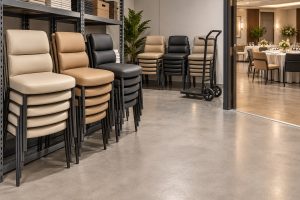
- Count stack and unstack cycles separately because contact between frames can abrade finishes even when the chair remains structurally sound.
- Note carries across thresholds, ramps or outdoor surfaces, where impact and twisting risks are higher.
- Mark whether each item was lifted, dragged, rolled on a cart or moved by two people.
Multiply the observed week by the operating calendar. The result is not a laboratory certification, but it lets you compare samples consistently. If a chair will be stacked twice a day for 250 operating days, its contact points may see about 500 stack cycles a year. That is a different purchase from the same chair used permanently at a fixed table.
Translate the number into table requirements
Tabletops and edges
Frequently moved tabletops need protected edges and a structure that resists racking. Ask how the top is fixed to the base, whether fasteners enter metal inserts or raw board, and whether the attachment can be retightened without damaging the substrate. Inspect the underside, not just the decorative surface. A beautiful top is a poor event choice if every lift concentrates force at a fragile apron or unsupported corner.
The dining table collection is a useful starting point for comparing shapes and base arrangements. For reconfigurable rooms, check that two tables meet without wide gaps, that corner radii do not create unusable seams, and that base locations leave space for chairs in both the single-table and joined layouts.
Bases, weight and floor contact
Low weight reduces handling effort, but a table must remain stable when guests lean on the edge. Review total weight, center of gravity and base footprint together. A compact pedestal can simplify chair placement, while a broad base may improve stability but catch feet or collide when tables are joined. Adjustable feet should have replaceable components and enough thread engagement to remain secure after repeated leveling.
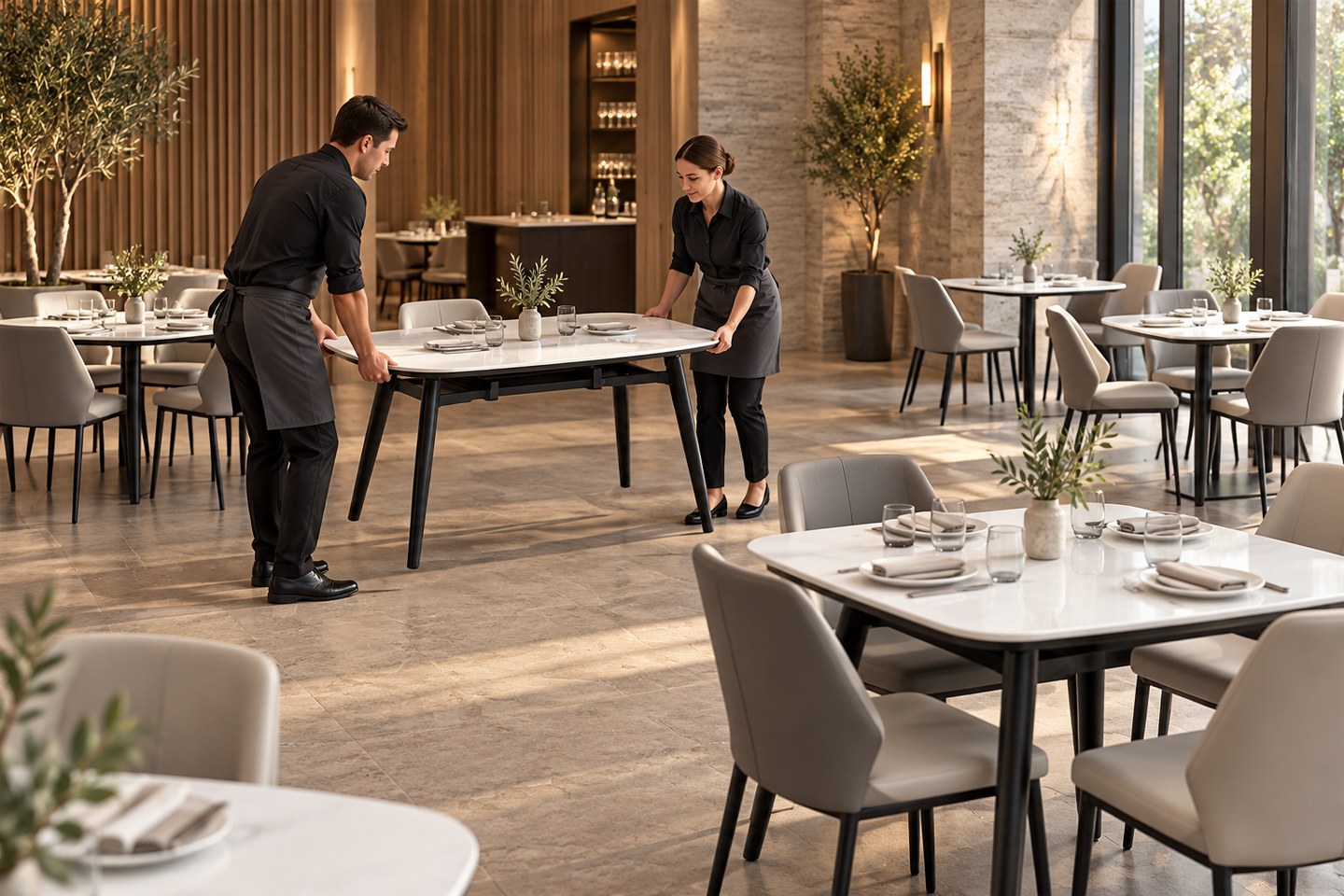
Specify an approved lift point. Staff should not lift a heavy top by one corner or pull a pedestal table from the top edge. If a table requires two people, write that into the reset plan. For frequent layouts, a compatible cart may save more labor and damage than choosing the lightest possible table.
Translate the number into chair requirements
Chair durability involves the joint system, frame geometry, upholstery and floor glides. A restaurant dining chair with a wraparound back may offer comfort, but buyers should still identify the safe handhold and check that staff do not lift by a decorative or upholstered section. On wood frames, watch mortise joints and corner blocks. On metal frames, inspect welds, mounting plates and threaded inserts.
Glides are consumable parts in a moving room. Confirm their material matches tile, timber, carpet or resilient flooring, and order spares with the first shipment. A missing glide changes chair height, exposes a leg end and can damage the floor. Also check whether stacked chairs touch at protected bumpers or rub upholstery against metal.
Run a movement trial before approving the order
A sample sitting test is necessary but incomplete. Reproduce the actual route from storage to dining room, the tight turn near the service station and the floor transition at the doorway. Use the staff members who will make the resets. Observe grip height, visibility, pinch points and whether the chair or table feels balanced.
- Photograph and label the sample, then tighten all accessible fasteners to the supplier’s guidance.
- Complete a realistic series of lifts, joins, separations, stacks and cart movements over several shifts.
- After the trial, place the item on its service floor and check wobble, joint movement, finish rub, edge damage and glide wear.
- Ask staff where the item was awkward to hold and whether two-person moves were practical during a fast reset.
- Record the result and keep the same inspection method for every competing sample.
Do not turn the trial into an abusive test. The goal is to model normal operations, not to drop furniture or exceed a stated stack height. If normal handling causes early looseness, the important question is whether the design, the moving method or the specification needs to change.
Build a move-frequency scorecard
Use a one-page scorecard with five headings: movement rate, handling method, structural response, surface response and serviceability. Give greater weight to issues that stop service. A finish scuff may be repairable; a loose base during dinner is an operational failure. Include the time needed to reset the room, because a technically durable item that doubles labor may still be the wrong choice.
- Expected chair and table moves per week, plus peak event days.
- Approved lift points, people required and compatible carts or dollies.
- Maximum stack count and protected contact points.
- Fasteners, glides and upholstery parts that can be replaced on site.
- Inspection interval and the supplier response for recurring looseness.
Match flexibility to the whole room
Furniture does not move in isolation. Map storage doors, service lanes, accessible routes, floor changes and emergency egress before finalizing quantities. A modular plan often works best with a core of stable everyday tables and a smaller flexible inventory for large parties. This avoids forcing every item to meet the most demanding event duty.
Compare the proposed chairs with the wider chairs and seating range, then ask whether one frame can support several upholstery or finish options. Standardizing hidden components can simplify spare parts while still allowing different zones to look distinct.
Put the operating brief into the order
Attach the movement profile, sample approval notes and handling requirements to the purchase record. Confirm supplied dimensions, finishes, glide type, replacement components and carton labeling. For a custom hospitality project, share the weekly move count and floor plan through the contact page so the discussion starts with the real operating conditions rather than a generic request for durable furniture.
After installation, inspect at 30, 60 and 90 days. If the same fastener or glide fails repeatedly, compare the location and move pattern before ordering a replacement batch. A good moves-per-week brief becomes a feedback loop: purchasing defines the duty, operations follows the handling method, and maintenance reports whether the assumption was accurate.
Frequently asked questions
What counts as a furniture move?
Count any lift, drag, roll, stack, unstack, join or separation that changes a chair or table from its normal service position. A four-top converted to two two-tops creates several handling events, not one.
Is lighter restaurant furniture always better for flexible rooms?
No. Lower weight helps staff, but stability, base footprint and center of gravity still matter. Test the lightest acceptable option on the real floor and with the largest intended table configuration.
How many move cycles should a sample survive?
Use a trial that reflects your operation. A venue making ten resets a week should simulate several weeks of moves, then inspect fasteners, glides, edges, upholstery and floor marks before approving the order.
Should move frequency appear on a purchase order?
Yes. Record the expected moves per week, approved moving method, stack limit, cart requirement and replaceable parts. Those details turn a vague durability request into a supplier question that can be answered.
Share this article: