Dining Table Family Selection: Use Related Designs for Different Jobs
Select related dining-table designs against each location’s job and keep shared appearance separate from functional approval.
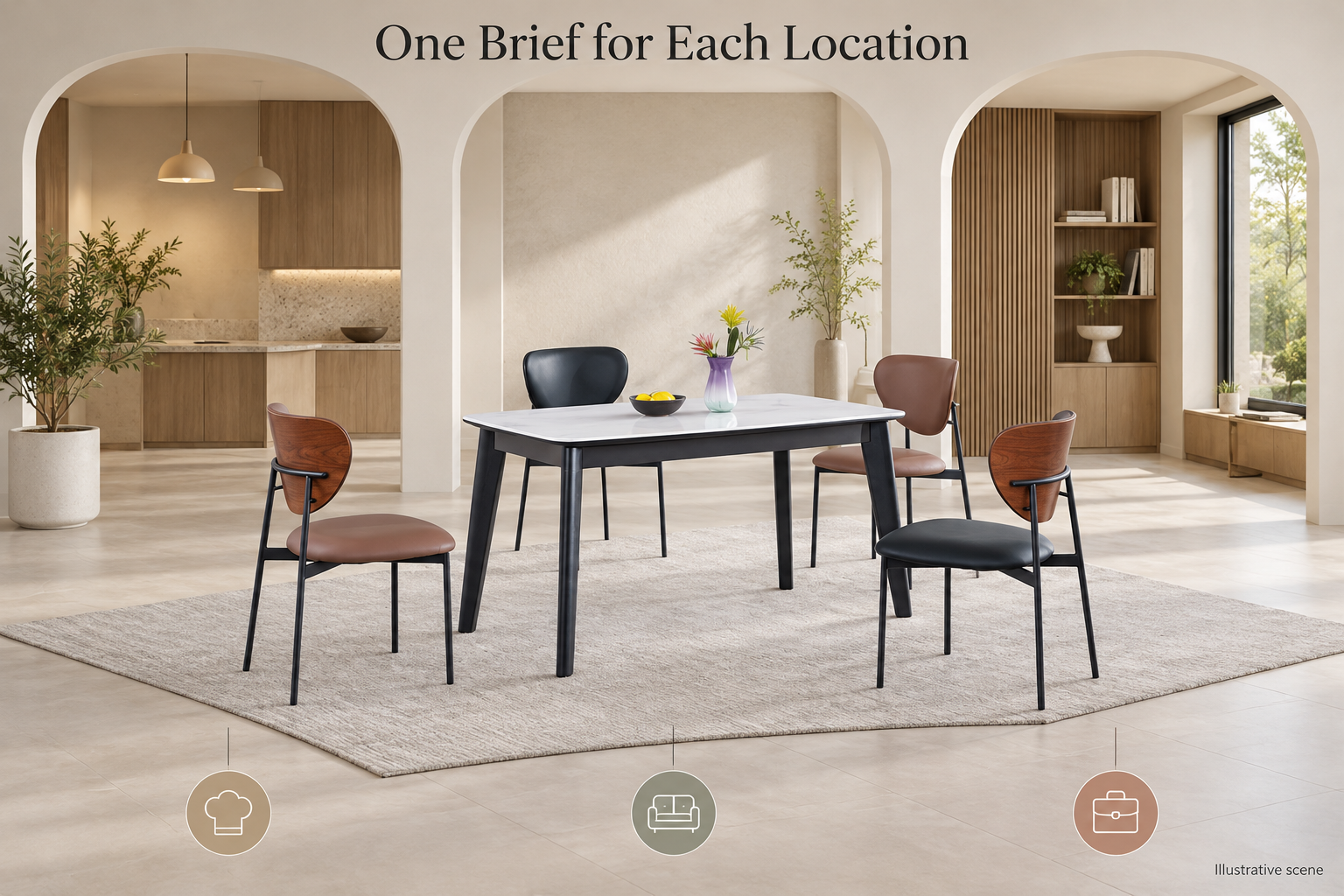
Dining table family selection can help a project establish a consistent appearance across several locations. The risk is allowing the shared collection name to hide differences in the work each table must do. A hotel breakfast space, restaurant dining group, and smaller staff dining area may need different configurations even when the visual scheme is coordinated. Begin with a separate brief for each location, then use the family resemblance to connect the accepted choices.
Give every location its own job
Describe the intended meal, group size, surrounding seating, and operating pattern. Identify retained chairs or fixed furniture that constrain the choice. A table intended for a settled dining group has a different movement requirement from one regularly reassigned to another layout. Keep those requirements specific to the location. Do not ask one design to perform every task merely because it would simplify the product list.
Record the relevant room and furniture dimensions for each proposed configuration. Shared top dimensions do not establish shared base geometry or chair compatibility. A related model can have a different underside or support arrangement, which needs its own review against the actual chairs. If some locations use different seat types, maintain that distinction in the schedule rather than assigning the same model universally and waiting for installation to reveal the mismatch.
Define the common appearance
Choose the qualities that should connect the project: a consistent top finish, a related edge treatment, a base color, or a recognizable silhouette. Ask the supplier which elements are actually available across the shortlisted models. A collection photograph does not establish that every size can use every pictured finish. The buyer may accept a common finish with different base forms if that better supports the separate locations.
Compare the selected models together using suitable current references. Check whether the apparent similarities remain coherent at their different scales. Decide where deliberate variation is acceptable and where a closer match matters. Keep the functional approvals separate from this appearance review. A strong visual family does not compensate for a table that fails its intended chair pairing or leaves insufficient surface for the location’s normal meal arrangement.
Order by location and configuration
Build a schedule listing each location, model, complete configuration, quantity, and accepted finish reference. Do not consolidate related models into one generic line described as matching dining tables. Identify any different handling or care instructions that operations need. If a model is revised or substituted, review the relevant location and its relationship to the family rather than accepting it because the supplier says it belongs to the same collection.
Use Hengyou’s finished dining table collection to discuss the current configurations that could serve the project. Availability of a coordinated family must be confirmed for the exact offer. Share the location briefs together so the supplier can propose related choices with their differences visible. The useful result is a coherent project assembled from tables that each have a defined job, instead of one repeated design chosen only because its name appears throughout a catalogue.
Share this article: