
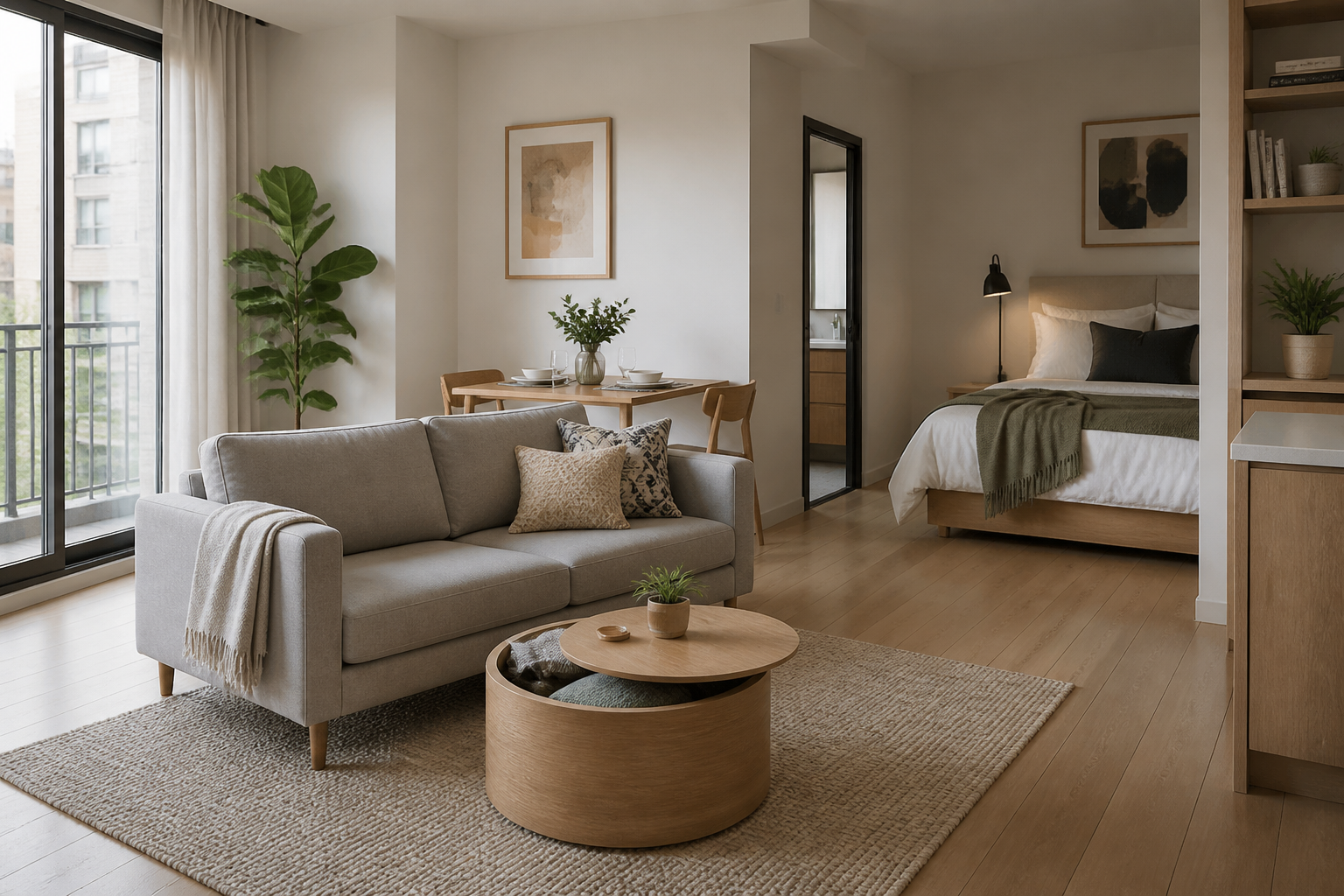
Coffee Table for Studio Apartment Zones is a practical question because furniture can look balanced in a photograph and still fail once chairs move, people sit, doors open, or staff begin service. Show how a table defines a zone through placement and rug relationship while preserving one continuous route.
The goal is not to force one universal rule. It is to create a repeatable way to compare size, comfort, movement, materials, maintenance, and future replacement before money is committed.
Quick Answer
Choose the table for the studio’s primary function and keep its footprint inside the seating zone. Rounded, nesting, or lift-top designs can help, but only when their moving parts have room to operate.
Key Takeaways
- Measure the active setup, not the furniture while everything is tucked away.
- Test the most constrained seat, route, edge, or operating condition first.
- Treat material, structure, cleaning, and replacement as one decision.
- For project orders, approve a sample and document the exact specification.
Start With the Real Use Case
Measure the seating, not the empty room. Record sofa or chair seat height, the usable seating span, the closest walking route, and every moving element such as a chaise, recliner, nesting table, lift top, or cleaning machine. Painter’s tape is more reliable than judging scale from a product photo.
For this topic, the most useful starting point is simple: Map the path from entry to bed, kitchen, and window. That first test establishes whether the furniture supports the room’s main job. It also stops secondary styling decisions from distracting attention from a basic fit or movement problem.
A Five-Step Room Test
1. Map the path from entry to bed, kitchen, and window
Start by making this visible in the real room. Map the path from entry to bed, kitchen, and window. For coffee table for studio apartment zones, the useful result is a measurement, observation, or approved detail that another buyer or installer can verify.
2. Keep the table inside the seating rug boundary
This should be checked with the furniture in use. Keep the table inside the seating rug boundary. For coffee table for studio apartment zones, the useful result is a measurement, observation, or approved detail that another buyer or installer can verify.
3. Test lift-top or nesting movement at full extension
Treat this as a pass-or-fail test, not a styling preference. Test lift-top or nesting movement at full extension. For coffee table for studio apartment zones, the useful result is a measurement, observation, or approved detail that another buyer or installer can verify.
4. Choose storage that is easy to access daily
Record the result before approving the final specification. Choose storage that is easy to access daily. For coffee table for studio apartment zones, the useful result is a measurement, observation, or approved detail that another buyer or installer can verify.
5. View the table from the apartment entrance
Repeat the test under the busiest realistic condition. View the table from the apartment entrance. For coffee table for studio apartment zones, the useful result is a measurement, observation, or approved detail that another buyer or installer can verify.
Size, Layout, and Clearance
Measure the seating, not the empty room. Record sofa or chair seat height, the usable seating span, the closest walking route, and every moving element such as a chaise, recliner, nesting table, lift top, or cleaning machine. Painter’s tape is more reliable than judging scale from a product photo.
| Decision Point | What to Check | Why It Matters |
|---|---|---|
| Check 1 | Map the path from entry to bed, kitchen, and window | Establishes the true footprint |
| Check 2 | Keep the table inside the seating rug boundary | Protects movement and access |
| Check 3 | Test lift-top or nesting movement at full extension | Reveals compatibility problems |
| Check 4 | Choose storage that is easy to access daily | Improves comfort and maintenance |
| Check 5 | View the table from the apartment entrance | Creates an approval record |
Materials and Maintenance
Coffee tables collect cups, remotes, books, snacks, pet hair, and cleaning products. Sealed wood is warm and repairable; stone and sintered surfaces handle heat differently; glass keeps a room visually open but shows marks; laminate and coated finishes vary greatly at the edge. The best choice is the one that matches the household’s real maintenance habits.
Ask for care instructions before selecting a finish. Test the proposed cleaner on a sample and inspect the edges, underside, joints, glides, and hardware that product photos rarely show. A surface that cleans easily but exposes a fragile edge or inaccessible joint is not a low-maintenance specification.
Common Mistakes
Buying multifunction furniture with unusable mechanisms
This usually happens when a product photo replaces a floor test. Buying multifunction furniture with unusable mechanisms. The practical fix is to return to the active footprint, intended users, and maintenance routine, then revise the specification rather than hiding the symptom.
Using the coffee table as a room divider
The problem may stay hidden until every seat is occupied. Using the coffee table as a room divider. The practical fix is to return to the active footprint, intended users, and maintenance routine, then revise the specification rather than hiding the symptom.
Filling every open inch with storage
It often creates extra cleaning, movement, or repair work later. Filling every open inch with storage. The practical fix is to return to the active footprint, intended users, and maintenance routine, then revise the specification rather than hiding the symptom.
Choosing a bulky top on a visually heavy base
A sample or taped layout normally reveals it early. Choosing a bulky top on a visually heavy base. The practical fix is to return to the active footprint, intended users, and maintenance routine, then revise the specification rather than hiding the symptom.
Ignoring how the table moves during cleaning or hosting
Correcting it before ordering is faster than redesigning the room later. Ignoring how the table moves during cleaning or hosting. The practical fix is to return to the active footprint, intended users, and maintenance routine, then revise the specification rather than hiding the symptom.
Product Selection Framework
Choose in this order: active footprint, reach, height, shape, base, surface, storage, and finish. Changing that order often produces a beautiful table that is uncomfortable to use or hard to walk around.
| Decision Point | What to Check | Why It Matters |
|---|---|---|
| Fit | Active dimensions, occupied clearances, reach, and movement | Reject options that fail the room test |
| Use | Visit length, seating posture, menu or household activities | Match furniture to the main daily job |
| Construction | Frame, base, joints, top, edge, glides, and mechanisms | Look beyond the decorative surface |
| Care | Spills, cleaners, sunlight, scratches, and access | Choose a finish the owner can maintain |
| Continuity | Samples, codes, parts, packing, and reorder terms | Keep later replacement practical |
Specification Checklist
- Focus topic, page title, and URL all match coffee table for studio apartment zones.
- Overall and active dimensions are recorded with units and tolerances.
- The lowest clearance, widest movement, and most constrained position are checked.
- Material, finish, base or frame, edge, glides, and hardware are approved.
- Cleaning instructions and a sample test are on file.
- Packing, assembly, lead time, spare parts, and reorder support are confirmed.
B2B Sourcing Checklist
For a bulk order, turn the room test into an approval document. Include dimensioned drawings, close-up photos, finish samples, chair or table pairings, acceptable tolerances, carton details, installation notes, and inspection points. Ask the supplier to identify which details may change in later batches and how replacements will be matched.
A production-close sample should be tested in context. Move it, sit at it, clean it, inspect the underside, and place it on the actual floor or a representative surface. Record the approved result with photos and measurements so the same decision does not have to be reinvented at delivery.
Related Furniture Options
Compare the proportions, surfaces, and base behavior of modern coffee table, sleek round coffee table, contemporary marble coffee table, modern round marble coffee table, storage marble coffee table, dual tier marble coffee table, contact our furniture team. Use these pages as visual and specification references, then confirm the final dimensions for the actual room.
Final Decision
A strong coffee table for studio apartment zones decision should survive four questions: Does it fit while in use? Is it comfortable for the intended visit or activity? Can it be cleaned and maintained with the available routine? Can the same specification be supported or replaced later? If one answer is uncertain, return to the sample or floor test before ordering.
That disciplined check produces a better room than adding more decoration around a furniture mismatch. It also gives homeowners, designers, operators, and sourcing teams a shared set of facts for approving the purchase.
FAQ
What should I check first for coffee table for studio apartment zones?
Start with the real use case and active footprint. Measure the furniture while occupied or operating, then protect the necessary route, reach, and maintenance access.
How can I test coffee table for studio apartment zones before ordering?
Use painter’s tape, a sample chair or table, and the actual room. Recreate normal use, full use, cleaning, and any moving parts rather than judging an empty setup.
Which material is best for coffee table for studio apartment zones?
There is no universal winner. Choose by spills, heat, sunlight, cleaning chemicals, scratches, repair expectations, weight, and how often the furniture moves.
What should commercial buyers document?
Record dimensions, tolerances, material and finish codes, base or frame details, glides or levelers, packing, lead time, sample approval, spare parts, and reorder terms.
How do I avoid ordering the wrong furniture?
Approve one realistic sample or mock layout, test it with the neighboring furniture, and keep the final measurements and finish references in writing.


